
AGV system in Velux - Vyskov - Czech Republic - AGVision
- Home
- AGV system in Velux – Vyskov – Czech Republic
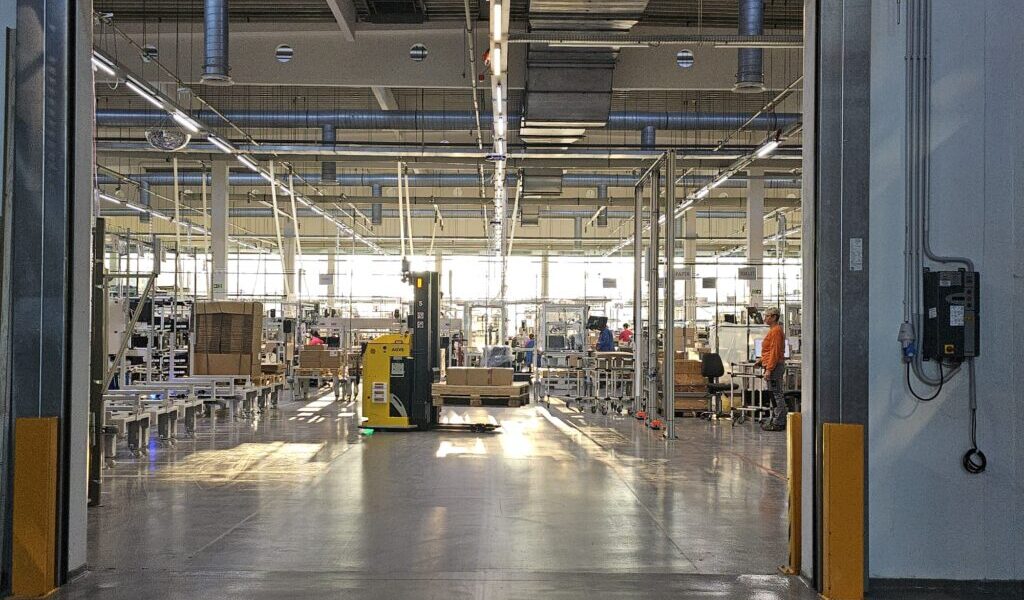

AGV system in Velux – Vyskov – Czech Republic
Velux, a Danish company, has factories in the Czech Republic where it produces the components for its skylights.
One factory in particular produces the electronic components for skylights equipped with automatic opening and closing, blackout blinds, and other functions.
At the aforementioned factory (BKR), Velux has decided to automate the warehouse with AGVs that can lift their forks up to the sixth level of the racking.
Furthermore, it has decided to take automation a step further with “turtle” AGVs that transport pallets and boxes from the warehouse to the production departments and vice versa, and from the production departments to shipping.
There are therefore two AGV systems coordinated and controlled by the same mission handling and traffic control computer.
The first AGV system is composed of six laser-guided AGVs, which transport pallets from a material input conveyor to the warehouse.
They also transport pallets from the warehouse to two stations where manual picking (decanting) takes place.
Boxes are removed from the pallet and placed at two adjacent stations.
A “turtle” AGV, with a structure mounted on it, waits to pick up these boxes and deposit them at a specific production station.
There are therefore nine turtle-style AGVs guided by QR codes (more than 1,000 QR codes have been placed in this facility) divided into three types:
- Five for pallets, which are placed under trolleys, lifted, and transported to the required location. A pallet with material is placed on the trolley.
- Two cardboard boxes from the decanting area are transported to production.
- Two plastic KLT boxes from the Kardex box warehouse are transported from the box warehouse to production and vice versa.
There is also a Shipping area, where the turtle AGVs (pallets) transport the finished products from production to shipping.
At the production exit, there is a label reading station where the host, based on the information red, assigns to the AGV the final destination (warehouse or shipping) based on the material on board.
The pallet flows from the warehouse to production (without passing through the decanting area) and from production back to the warehouse, are sorted via docks that interface between the A4 AGVs (warehouse) and the L2 AGVs (turtle).
This is a highly efficient integrated system; in fact, BKR/Velux frequently receives visits from partners or other companies curious to see it in operation.
In this AGV control system, the central computer manages and controls approximately 1,100 digital signals in the field, including photocells, buttons, lights, etc.
Because of so many stations, signals and QR codes, the testing phase has been crucial in this system.
Most of the tests neede to be carried over the weekends to don’t disturb production. Some of them have been done during night.
Standard rules for naming signals and stations have been applied to communicate with the host easily.
The “top” host is SAP that communicate with us via a software layer developed directly from Velux Denmark.
Another crucial point have been the communication with the PLC that controls a conveyor system.
We have been lucky that all engineers part of the team were enough skilled and with experience, so that we could put the project on the right direction from the beginning.
AGV navigation type: Laser for the A4 AGVs and QR codes for the L2 AGVs.
AGV system controller: a server provided by the customer, where our system and SQL server have been installed. Communication with the host is via TCP/IP, communication with signals is via Modbus, communication with PLCs is via UDP, communication with the AGVs is via WiFi.
Charging concept: charging stations with contacts on the side of the AGV (A4) or in front of it (L2), when batteries are low, the vehicle is sent there to stay and charge, as well the AGV goes on charger when there are no transports to execute.
This AGV system is working over three shifts.
Number of AGVs: 6 A4 + 9 L2
AGV manufacturer: AGVE
Function: AGV navigation software and AGV system manager development, plus on site project leader
Year: 2023